
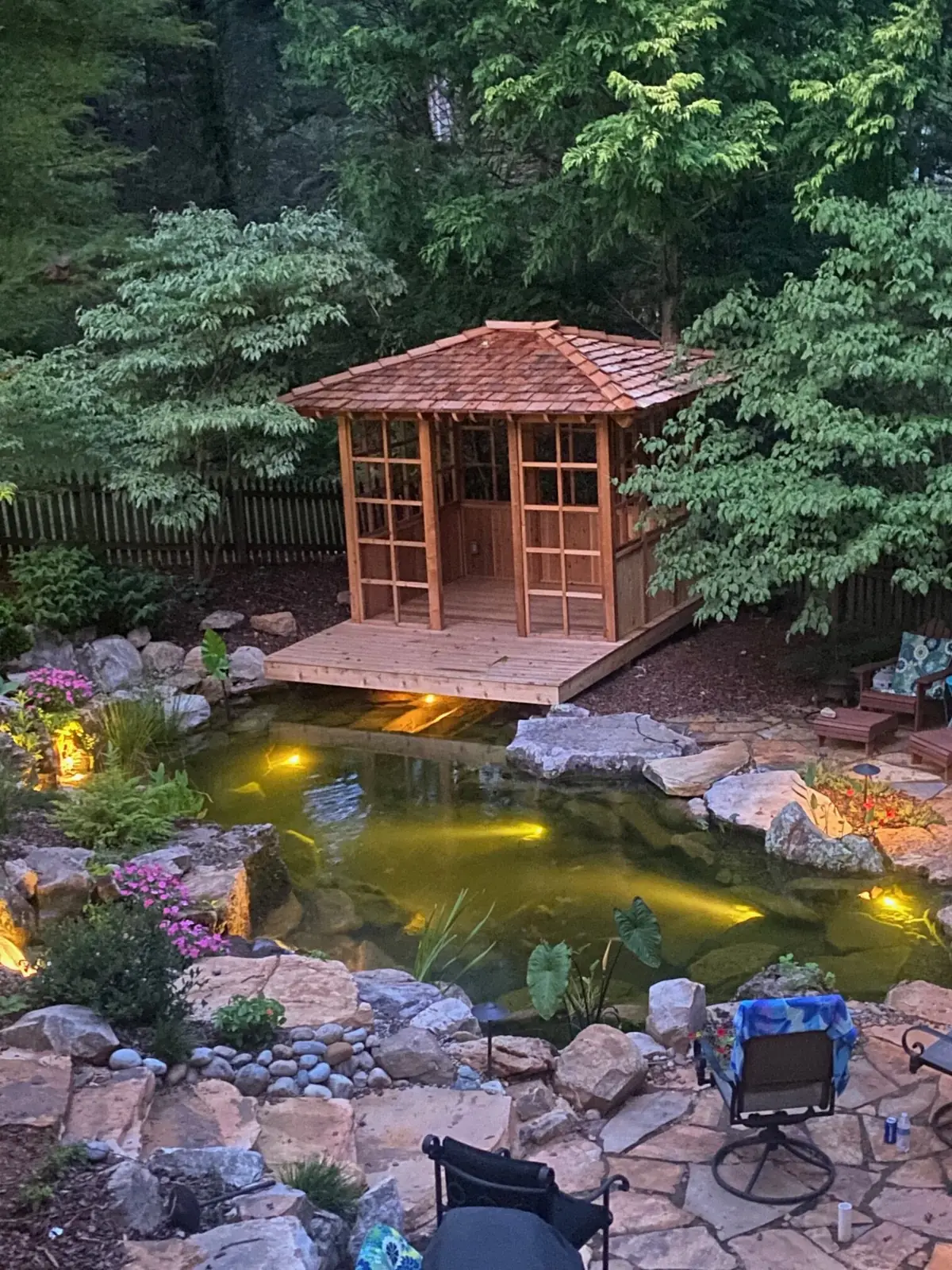
Landscape and Outdoor Lighting in Charlotte, NC
Low-voltage LED lighting for paths, trees, stonework, the house and the water. Designed to show off the yard after dark, without glare, for homes across Charlotte, Belmont, Gastonia, Lake Norman and Lake Wylie.
Not sure what you need? Answer three quick questions

- Serving the Charlotte region since 2002
- Master Certified Aquascape Contractor
- BBB A+
- State licensed and insured
Two landscapes: one by day, one by night
You spend real money on plantings, stone and water, and then for half the year it disappears at 6pm. Good landscape lighting in Charlotte gives you that investment back after dark: the path from the driveway, the big oak in the front yard, the waterfall you hear from the patio but cannot see.
We approach lighting the way we approach a pond or a planting plan. Start with what deserves to be seen, light it softly, and keep the fixtures themselves out of sight. Because we also build ponds, waterfalls and landscapes, we design the lighting as part of the whole yard, not as an afterthought bolted on at the end.
LED landscape lighting
- Path and step lighting
- Tree uplighting
- Hardscape and wall lighting
- Architectural lighting
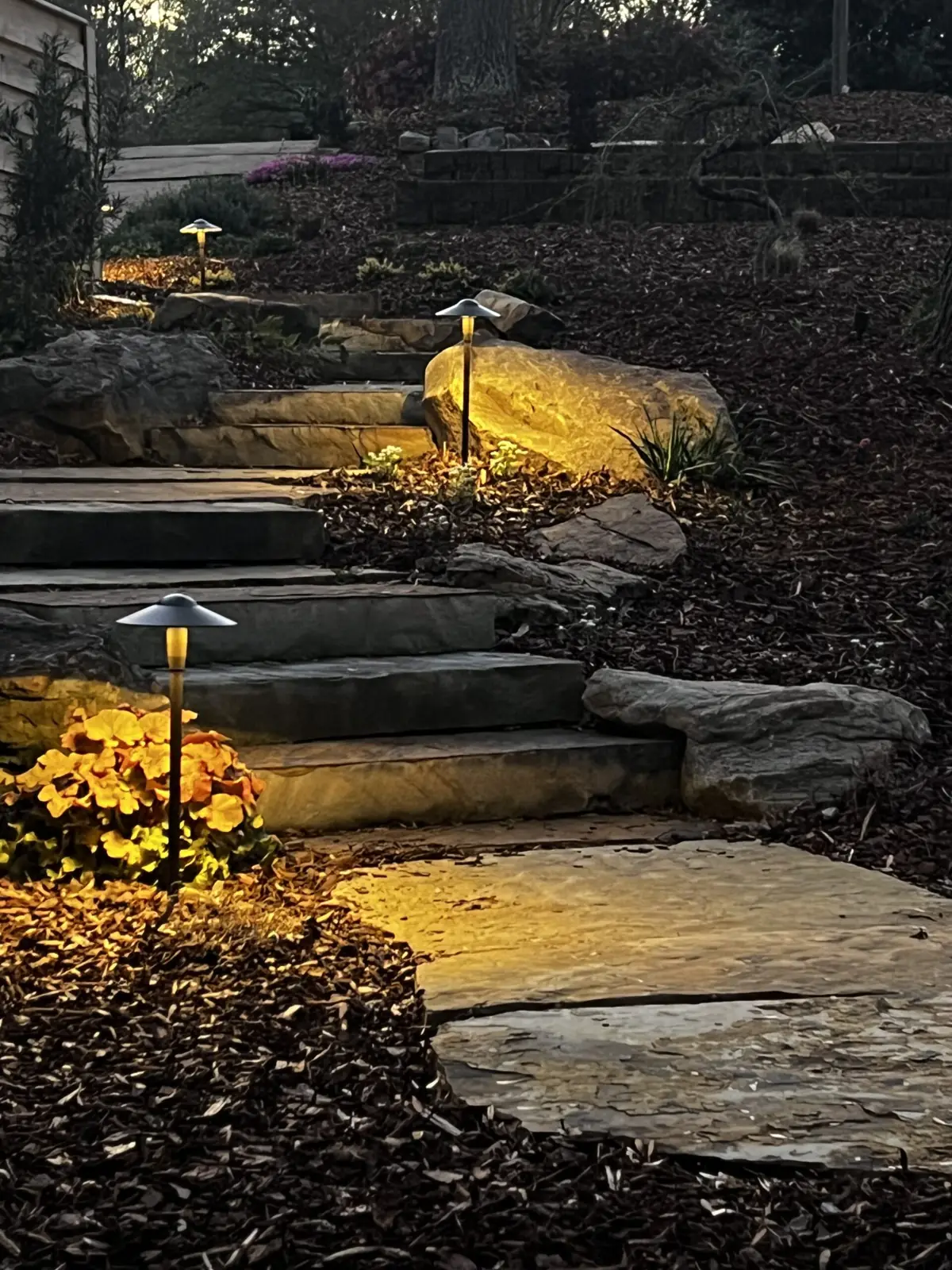
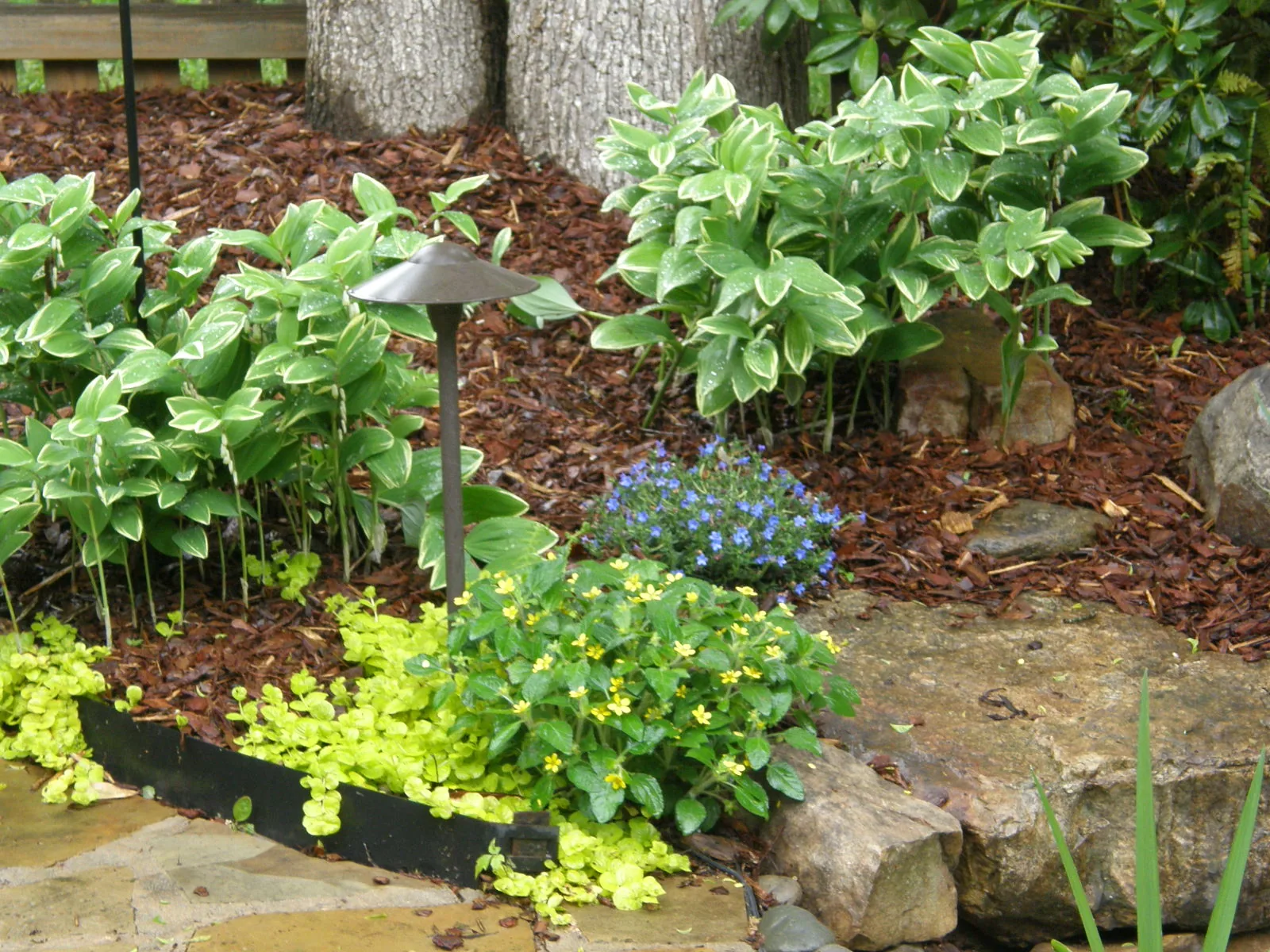
Path and step lighting. Low path lights and lights set into steps and walls mark the way from the driveway to the door, around the pool deck, or down to the pond. The goal is a soft pool of light on the ground where you walk, not a runway of glowing posts.
Uplighting trees. A mature oak, magnolia or Japanese maple lit from below becomes the anchor of the whole night landscape. Large canopies often need two or three fixtures from different angles so the tree looks full rather than flat. We sometimes light specimen trees front and back so they read well from both the street and the patio.
Hardscape and stonework. Boulders, retaining walls, stone steps and patios pick up texture when light grazes across them at a low angle. Our signature specimen boulders are especially good at this.
Architecture. Gentle wash lighting on the face of the house, columns or a stone chimney adds depth and curb appeal. We keep it warm and restrained, so the house looks lived in, not floodlit.
Pond and waterfall lighting
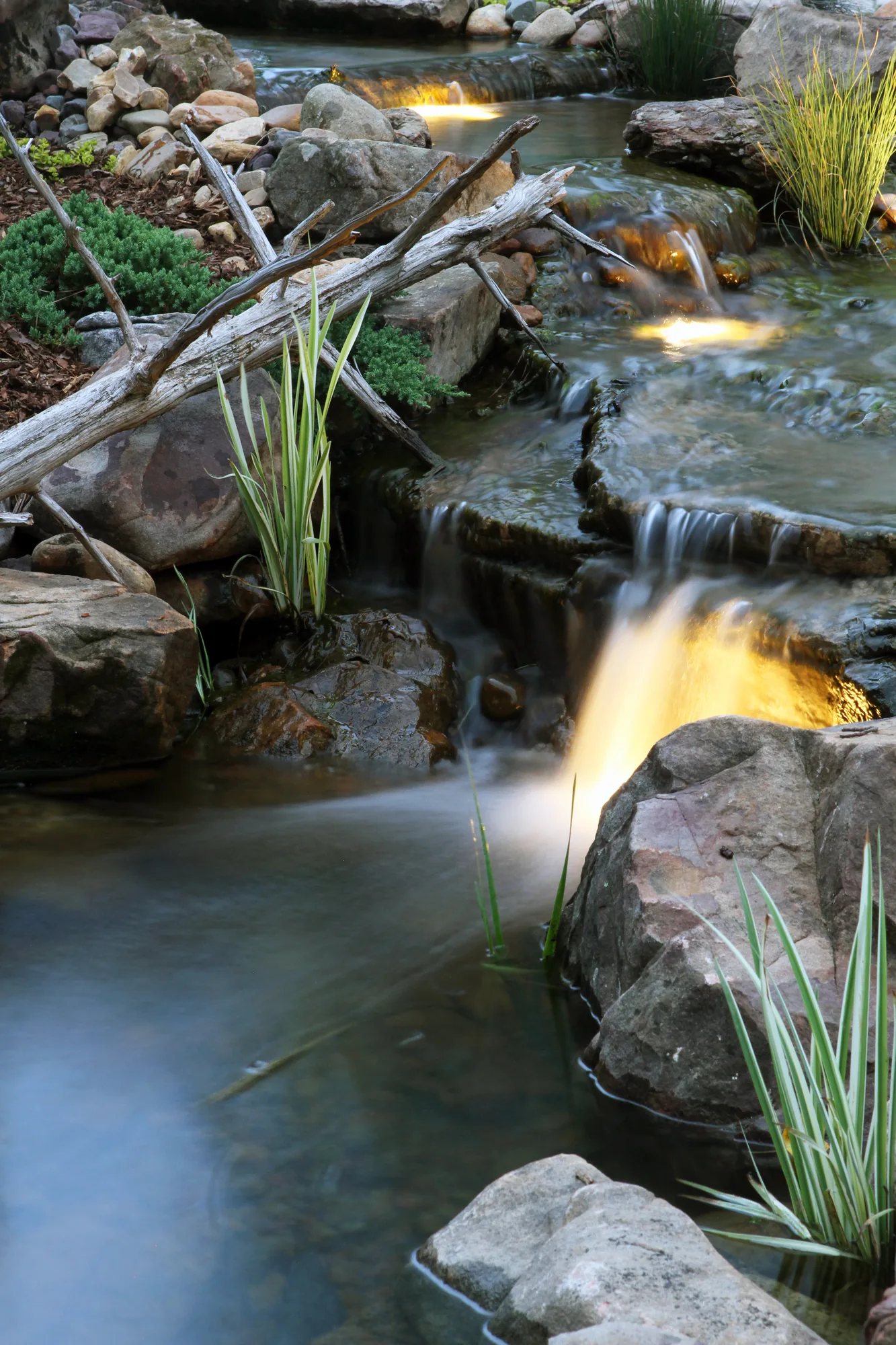
Water is where lighting really pays off. Moving water catches light and throws it around in a way nothing else in the yard can.
Underwater lights. Submersible LED fixtures placed in the pond show off the water, the plants and the fish. We tuck them behind rocks so you see the glow, not the fixture.
Lighting the falls. A light set at the base of a waterfall, aimed up into the falling water, makes the whole cascade glow. On larger waterfalls, smaller lights on secondary drops add depth. On a Belmont pond renovation, we lit the main waterfall with a 3-watt LED and the two smaller falls with 1-watt lights. That is all it took. See the Belmont pond and waterfall revival.
Around the water. Path lights near the edge and a few accents on nearby plantings tie the pond into the rest of the landscape and make it safer to walk around at night.
If you are planning a koi pond or waterfall, it is much easier to plan lighting from the start, so the wiring is hidden in the build instead of added later. For more ideas, read how to bring pond lighting into your design.
Why low-voltage LED
We install low-voltage LED systems. Here is why:
- Low running cost. LEDs use a small fraction of the power of the old halogen and incandescent landscape lights, so leaving them on every night does not show up much on the power bill.
- Long life. LED fixtures last for years, and many quality fixtures carry 10 to 15 year manufacturer warranties.
- Safer near water and people. A transformer steps household current down to low voltage before it runs out to the fixtures, which is the right choice around ponds, paths and planting beds.
- Warm, controllable light. Quality LEDs come in warm white tones that flatter stone, foliage and brick, and many can be dimmed.
Safety and security
Lighting is not only for looks. Lit paths, steps and pond edges mean fewer trips and stumbles, especially for guests who do not know the yard. A well-lit house is also a less inviting target. The difference from a builder's floodlight is that good landscape lighting provides that visibility without blinding anyone or lighting up the neighbors' bedrooms.
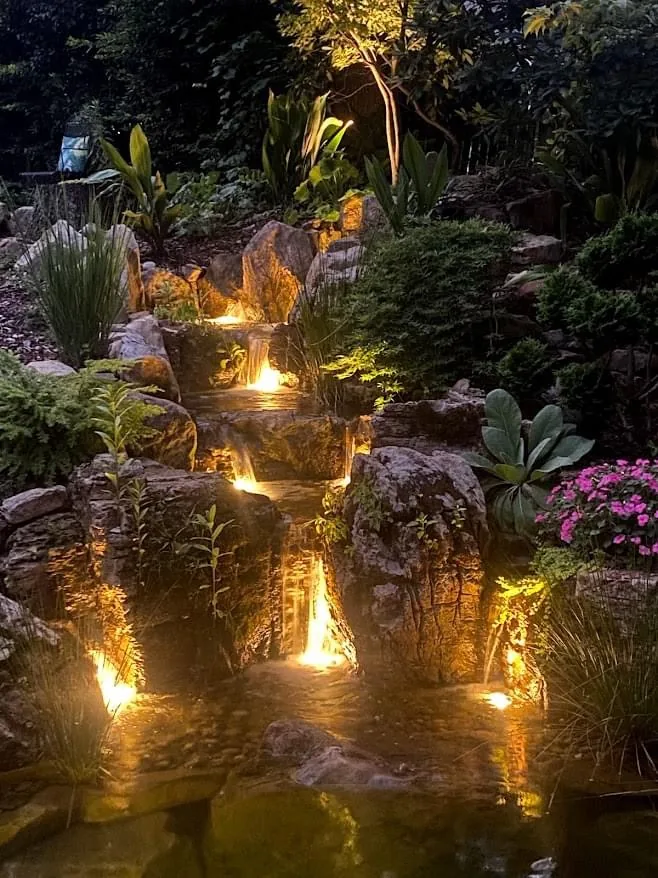
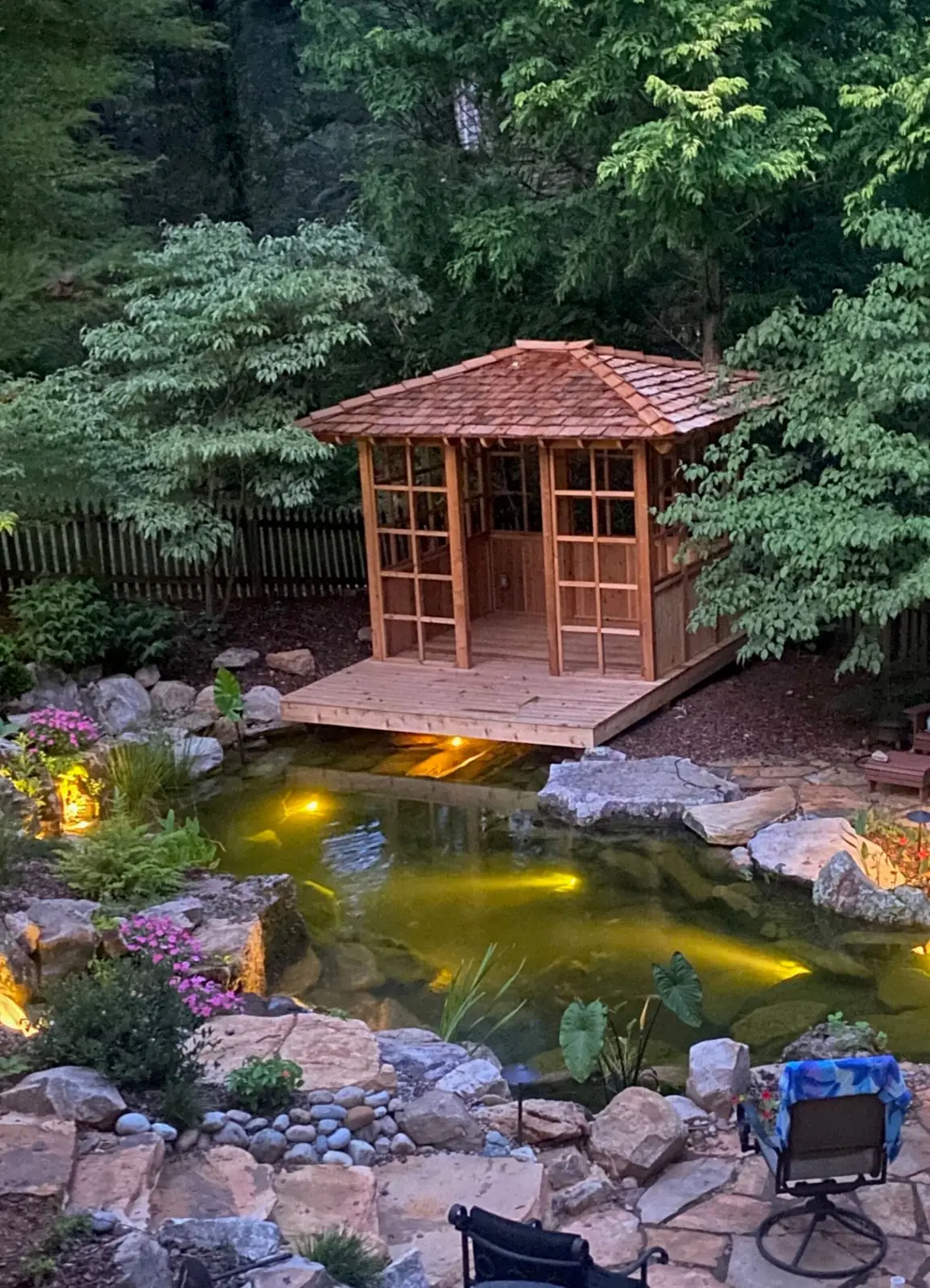
How we design a lighting plan
Light the destination. We start with the places you want your eye to land: the front door, a specimen tree, the waterfall, the seating area. Everything else supports those.
Avoid glare. The most common mistake in landscape lighting is seeing the bulb instead of the thing it lights. We aim fixtures away from where people sit and walk, use shielded fixtures, and hide them in plantings and behind stones.
Layer it. A good night landscape has several layers: soft light on the paths, accents on trees and stone, a glow from the water. Some areas stay dark on purpose. Shadows are what give the lit areas depth.
Keep it warm and restrained. Less light, well placed, almost always looks better than more light everywhere.
Smart controls and timers
Every system needs a way to turn on and off without anyone thinking about it. Options range from a simple timer or a photocell that turns the lights on at dusk to smart controls you can adjust from your phone, with different zones on different schedules. We will recommend what fits how you use the yard.
Upkeep
Low-voltage LED lighting needs little care, but it is not zero. Plants grow and start to block fixtures, mulch gets piled over path lights, and a fixture can get bumped out of aim by a mower or a dog. Underwater lights collect algae and leaves on the lens and need an occasional wipe. In fall, check that leaves have not buried fixtures, and after storms, look for anything knocked out of place. If your pond is on one of our pond maintenance plans, we keep an eye on the pond lights during regular visits.
Lighting with water features and landscaping
Lighting often comes as part of a larger project: a new pond, a renovation, a pondless waterfall, a fresh landscape design. On a Huntersville project, after we built a large pondless waterfall, we added low-voltage path lights and spotlights to show off the falls and key plants, then lit the front walk and an existing Japanese maple from both sides. If your current pond needs work too, lighting fits naturally into a pond renovation. We also install lighting on its own for existing landscapes.
Outdoor lighting in Belmont, Gastonia and Lake Norman
Our shop is in Belmont, and we have worked across the Charlotte region since 2002. Outdoor lighting in Belmont and Gastonia gets the same design visit, the same low-voltage LED systems and the same crew as a Charlotte yard, because Gaston County is home ground for us. See our Belmont and Gastonia pages for the other work we do nearby.
Around Lake Norman, the yard, the house and the water are all seen at night, so lighting the path to the water, a specimen tree or a waterfall makes a real difference. Our crew drives up from Belmont to Cornelius, Huntersville, Mooresville, Denver and Sherrills Ford. More on our Lake Norman page.
Questions
Frequently asked questions
It depends on four things: how many fixtures the plan calls for, the transformer that powers them, how far the wire runs have to go, and the controls you choose, from a simple timer to a smart controller. Lights in the water add to the job. A few path lights and one uplit tree is a very different job from lighting a whole property and a waterfall. We do not publish lighting prices. We start with a design visit to your property, then give you a clear plan and a firm price.
Yes. Quality LED landscape fixtures are more than bright enough for paths, trees and architecture. Most well-designed systems use less light than people expect. The goal is to see the tree, not the fixture, and a soft, warm light placed well looks better than a bright one placed badly.
Usually, yes. We can tuck underwater lights behind rocks and run wiring along the edge of the pond, hidden by stone and plantings. On some ponds it is easier to add lighting when other work is being done, such as a cleanout or a renovation, because the rocks are already being moved.
Yes. Low-voltage submersible LEDs run cool and are built for underwater use. Fish swim around them without any trouble. As with any pond equipment, the system should be installed on a properly protected circuit, which is part of how we install it.
Most systems use a timer, a photocell that switches on at dusk, or a smart controller you can adjust from your phone. Different areas can run on different schedules, for example the path lights all night and the waterfall until bedtime. We set it up so you never have to think about it.
Yes. Lighting is often part of a larger pond or landscape project, but we also design and install lighting on its own for existing yards, ponds and water features across the Charlotte area. If we notice a related issue during the visit, such as a pond that is losing water, we will mention it, with no obligation.
Get started
See your yard after dark.
Tell us what you want to light and Brian will walk you through a plan. Call 980-522-6166, Monday to Saturday, 8am to 6pm, or start below.